Quality & Testing

Quality is built into production, not promised after it.

Testing and inspection happen inside production at our Shenzhen factory: at incoming material, during production and assembly, and before the goods are packed. The eight checks below are the capability we publish; which of them a particular order receives is agreed with the project.

Test area, Shenzhen factory

01 — Scope of testing

A test is chosen for the product,
not copied from a list.

The eight checks published below are what the factory is equipped and trained to run. Which of them a given model goes through depends on four things, and the answer is written into the project before production starts.

Scope of testing

Testing is performed according to product type, material, target market and project requirements. Not every test applies to every model.

Product type

A picture light and a wall light, a hardwired and a rechargeable model, are not the same electrical or mechanical thing, so the checks that matter to them differ.

Material

Powder coating, plating, aluminium, glass and acrylic age differently. The material decides which durability test is worth running and what it will show.

Target market

The market the goods are sold into decides how demanding the climate-related checks are, and which conformity documents the buyer will need to see.

Project requirements

A buyer may name a standard, ask for a test to be repeated after a change, or have one part checked on its own. Those requirements are agreed per project.

Testing and quality control described on this page are carried out at our own factory in Shenzhen: Building 1, Mingrenju Industrial Park, Kengzi Subdistrict, Pingshan District, Shenzhen, China

02 — Tests and inspections

Eight checks,
and what each one is for.

Each entry states what is tested and how, what the check is there to prevent, which products and materials it concerns, and the stage of production it happens at. Photographs of the equipment and the working process are added as the real files become available.

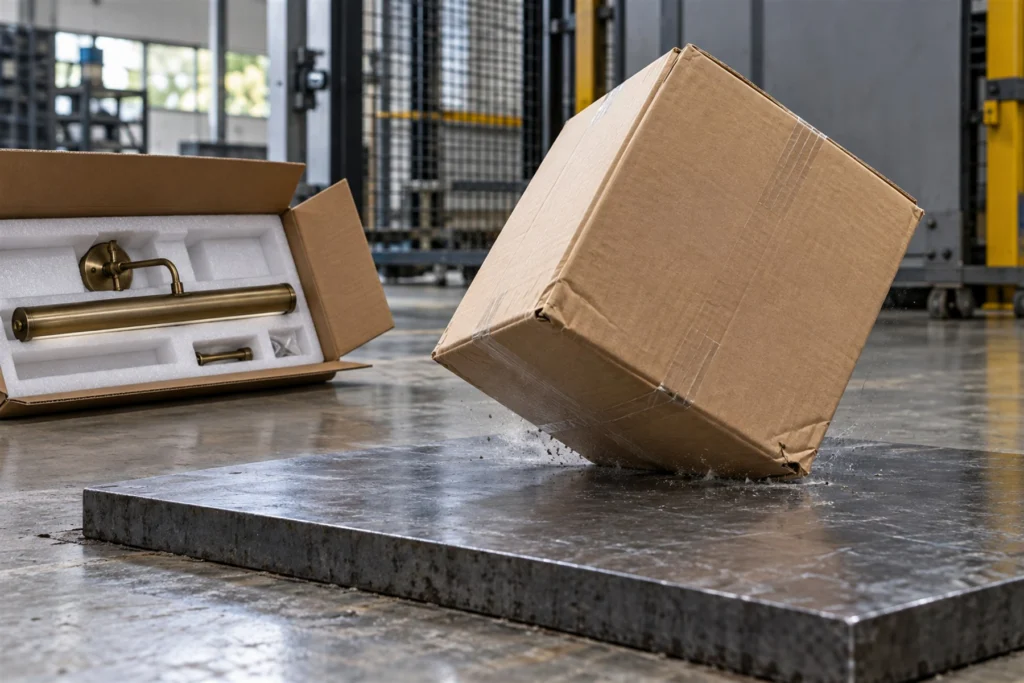
Drop test on a packed carton

Test 01

Drop Test

What is tested, and how
A packed unit is dropped from a defined height onto a hard surface, in the orientations agreed for the project.
Why it is done
It shows whether the carton and the internal packing still protect the product after handling, palletising and transport, and whether a housing, diffuser or fixing breaks when a parcel takes a knock.
Applies to
Finished models in their shipping carton. Most relevant where the fixture carries glass or acrylic, and where the sales channel ships parcels rather than full pallets.
Stage
Pre-shipment, on packed goods, and repeated whenever the packaging changes.
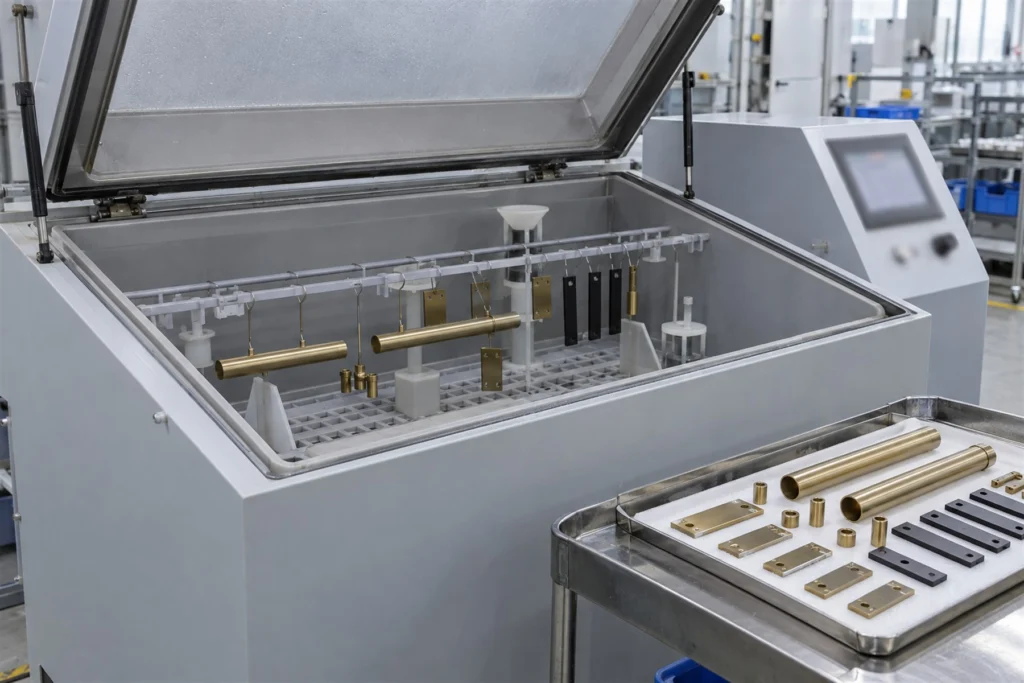
Salt spray chamber with test parts

Test 02

Salt Spray Test

What is tested, and how
Metal parts and finished components are exposed to a salt fog in a chamber, at the exposure time and salt concentration fixed by the test the project requires.
Why it is done
It shows how a plated, painted or powder-coated surface resists corrosion — blistering, white rust, colour change — before those parts go into products sold into humid or coastal markets.
Applies to
Metal bodies, brackets, plated and painted hardware and the visible surfaces of a finished fixture. The material and the finish decide whether the test is meaningful for a given model.
Stage
Incoming material and finished parts, before those parts are released into production.
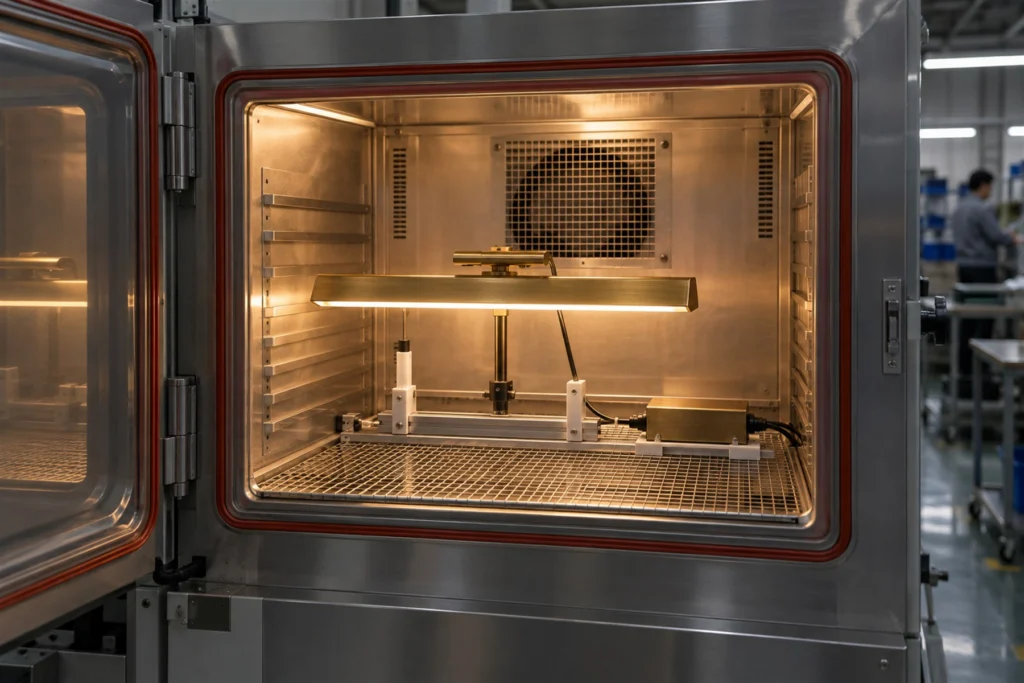
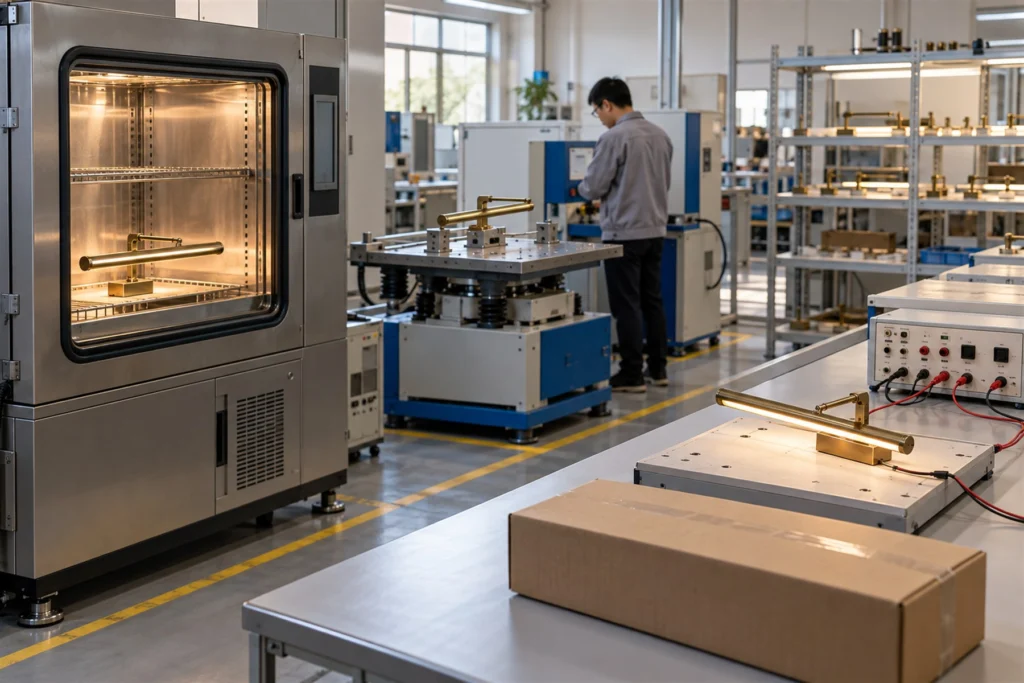
Temperature chamber with a fixture

Test 03

High & Low Temperature Test

What is tested, and how
Drivers, batteries, control electronics and complete units are held at agreed high and low temperatures, and cycled between them where the project asks for it.
Why it is done
It catches what a comfortable workshop never shows: driver or battery protection cutting out, sensor and control faults, condensation, and paint, adhesive or diffuser behaviour outside normal room conditions.
Applies to
Mains-powered and rechargeable models, and anything carrying a driver, battery, sensor or dimmer, together with the finishes and materials around them.
Stage
Product validation, on samples and the first article, before a production run is released.
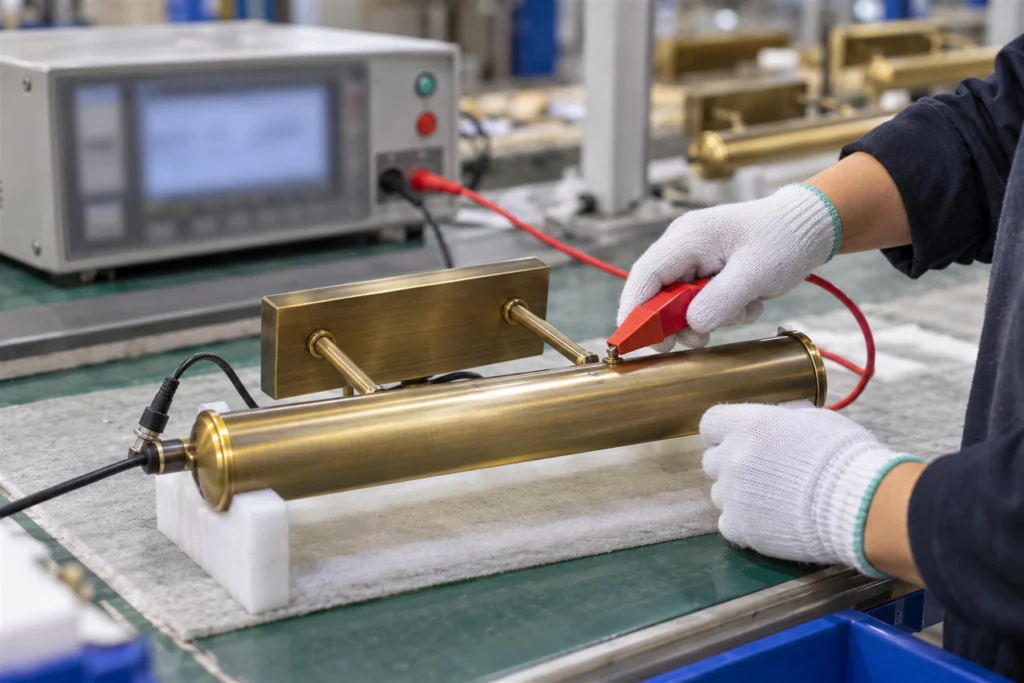
Hi-Pot test on the line

Test 04

Hi-Pot Test

What is tested, and how
With the fixture wired and assembled, a test voltage is applied between live conductors and accessible metal or earth for a defined time, and the leakage current is read.
Why it is done
It shows that the insulation, the internal wiring, the driver and the earth connection are sound, so a unit with a shock or short-circuit fault is found and stopped at the factory.
Applies to
Mains-powered models, hardwired and plug-in, and the charger or adaptor supplied with a rechargeable model, wherever the project requires it.
Stage
Assembly, on wired units, before the unit is packed.
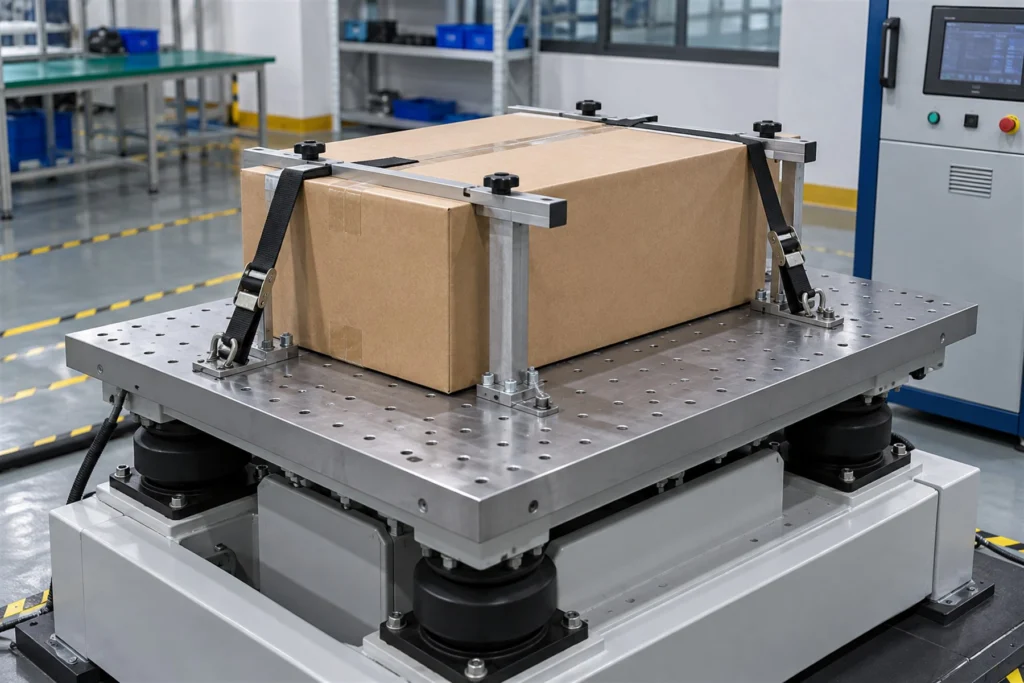
Vibration table with a packed unit

Test 05

Vibration Test

What is tested, and how
A packed unit or a bare fixture is vibrated on a table for a defined time, reproducing the road, rail and sea movement of a shipment.
Why it is done
It finds what a long journey loosens: solder joints, terminal screws, connectors, fixings, light engine or battery retention, and it shows whether the carton lets the product move inside it.
Applies to
Finished models and packed goods, most relevant to models carrying electronics, glass parts or long arms, and to goods travelling by sea.
Stage
Pre-shipment and packaging validation, on pilot lots, before the shipment is released.
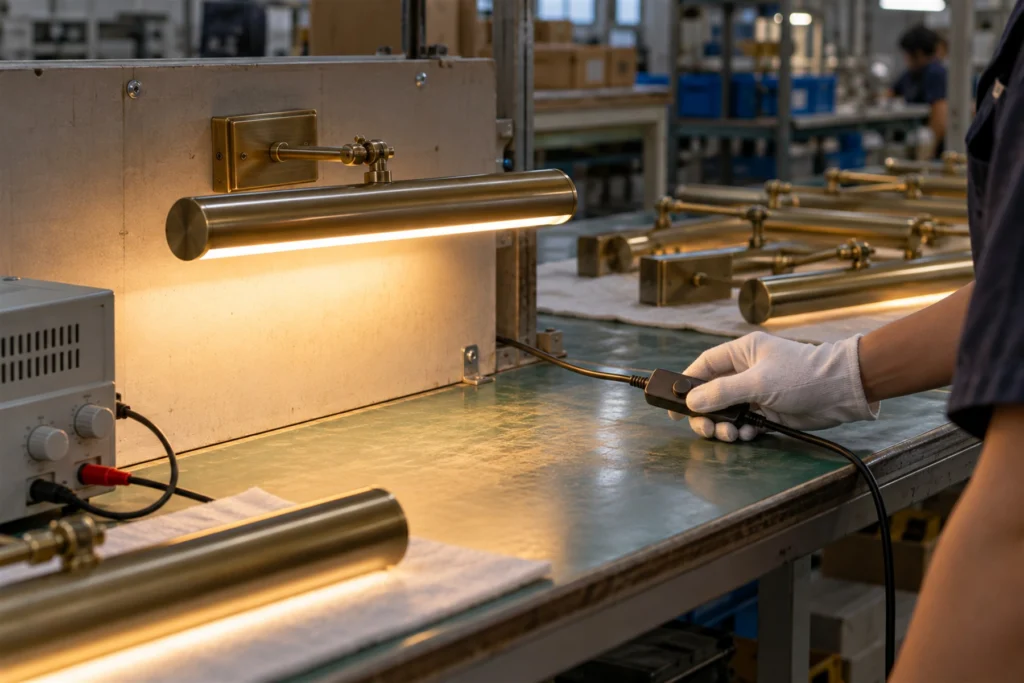
Functional test station

Test 06

Functional Test

What is tested, and how
The unit is powered up and every function it is sold with is operated: switching, dimming or touch control, sensor and remote behaviour, charging, output colour and light level.
Why it is done
It confirms that an assembled model behaves as its specification says, so a fault is found at the factory rather than at the buyer's bench: electrically safe is not the same as working.
Applies to
Every powered model, in the functions and accessories of the configuration that was ordered.
Stage
After assembly, and again on packed goods before shipment.
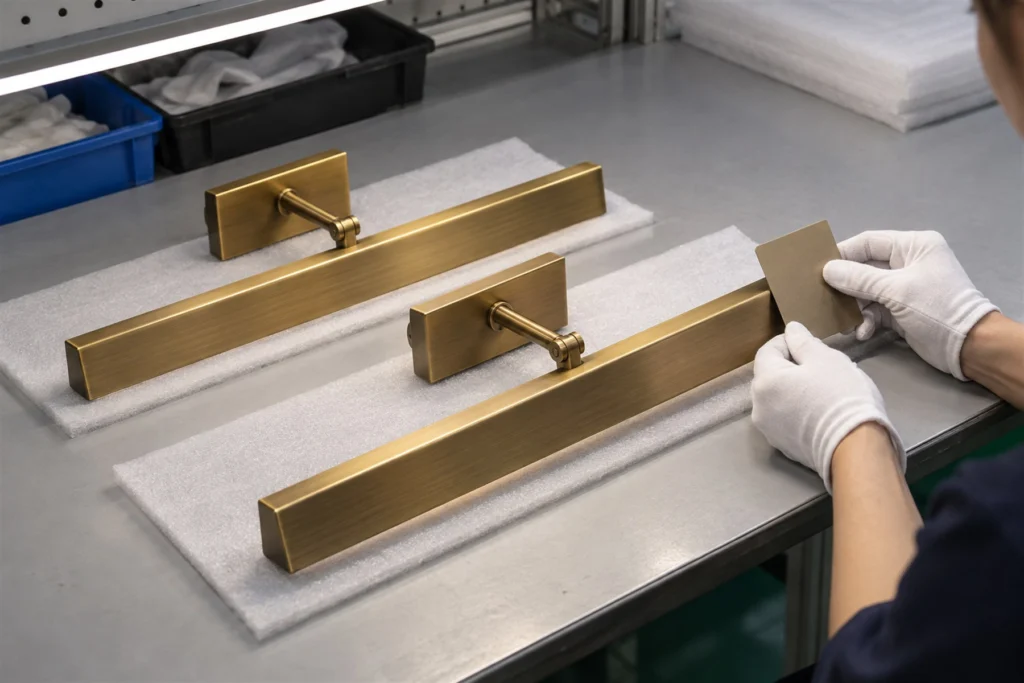
Appearance inspection bench

Test 07

Appearance Inspection

What is tested, and how
A trained inspector compares each unit with the approved sample and the order specification under defined lighting: finish and colour uniformity, plating, glass or acrylic clarity, alignment, print and label position, and the hardware fitted.
Why it is done
It catches what function never shows — scratches, dents, colour drift between batches, a misaligned shade, a marked diffuser or the wrong finish — and stops a shipment whose appearance is not what the buyer approved.
Applies to
All models, and especially orders with a specified finish or metal, a private label, or retail-ready presentation.
Stage
In-process during production and at pre-shipment, on finished units.
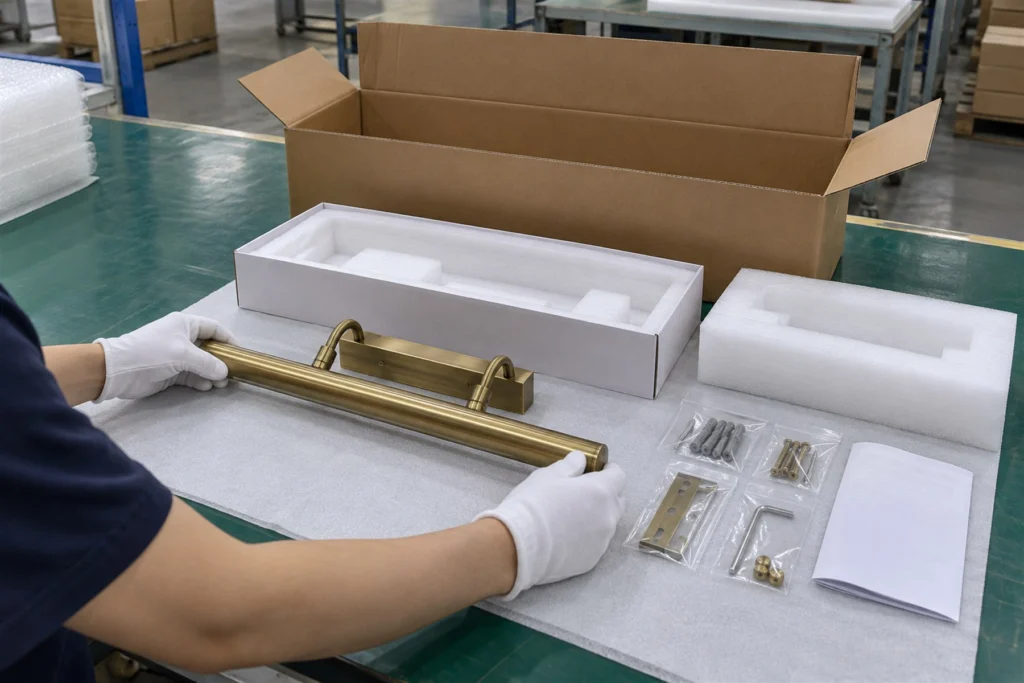
Packing line and carton check

Test 08

Packaging Inspection

What is tested, and how
Carton, inner packing, protective inserts, accessory bag, manual, labels and barcode are checked against the approved packaging and the order documents, together with the packed unit and the master carton.
Why it is done
It prevents goods arriving damaged and a pallet being refused at the buyer's warehouse over a wrong label, a missing accessory, an incomplete manual or non-compliant carton marking.
Applies to
Every order; most demanding for private-label packaging, retail-ready cartons and mixed container loads.
Stage
Pre-shipment, extended to the container loading check.

Not every test applies to every model: the scope sentence above decides which of these checks a given order receives, and that scope is confirmed in writing before production.

03 — The quality flow

Where the checks sit
in a production order.

Quality is a sequence of gates rather than a single inspection at the end. An order moves through the stages below at the Shenzhen factory, and each gate is cleared before the next one starts.

  1. Stage 01

    Incoming material and part confirmation

    Components, drivers, LEDs, metal parts, diffusers and finishes are checked on arrival against the approved samples and the purchase specification, before they are released to the line.

  2. Stage 02

    In-production checks

    Checks sit where a fault is easiest to see and cheapest to correct: material and finish before assembly, wiring and electrical safety after assembly, appearance throughout. The first units of a new model, or of a model whose component, finish or supplier has changed, are compared with the approved sample before the line continues.

  3. Stage 03

    Finished units: function and appearance

    Every powered unit is energised and its functions are operated, and the appearance of the finished unit is judged against the approved sample under defined lighting before it is packed.

  4. Stage 04

    Packaging check

    Carton, inner packing, protective inserts, accessory bag, manual, labels and barcode are checked against the approved packaging and the order documents as the units are packed.

  5. Stage 05

    Pre-shipment confirmation

    Finished goods are inspected in their packaging before they leave the factory, and the packed carton and loading plan are checked again as the container is loaded, with the record kept in the order file.

When something does not pass

  • The finding is recorded against the order, the unit or the batch, with the check it failed and the date.
  • The affected units are separated from released stock and held back, so they cannot be packed into the order by mistake.
  • The cause is traced in material, component, process or drawing, because the same fault twice costs a second shipment.
  • Rework, replacement or a written concession is agreed with the buyer before the goods move.
  • The check that failed is repeated on the reworked units, and they are released only once it passes.

Sampling levels, acceptance numbers, how a non-conforming quantity is settled and who carries the cost are agreed in the project and confirmed in writing. They are not published here.

04 — Testing and certification

Testing is done here.
Certification belongs to a model and a market.

The two are connected but not interchangeable, and buyers often need to know which of them they are asking for. This page keeps them apart.

Testing: a capability we run ourselves

  • The checks above are performed in our own factory, on our own equipment, by the team that builds the product.
  • Which checks a model receives is decided per project by the product, the material, the target market and the project requirement.
  • A check is repeated when a component, a finish, a supplier or a packaging changes, so a result stays attached to the configuration it was obtained for.
  • Results are reported to the buyer in writing for the model concerned: a report describes one configuration, not the whole range.

Certification: a document for a model and a market

  • A conformity document belongs to a specific model and a specific target market: the same fixture may be certified for one market and not for another.
  • Whether a model holds the document a market requires, and which document that is, is confirmed by email for that model and that market.
  • Duties that fall on the market rather than on the product, such as registration and take-back obligations, are handled with the buyer for the market concerned.
  • No certification status and no certification mark is published on this website, because a status shown here could be wrong the moment a model or a market changes.

05 — Documents and reports

What we publish,
and what is confirmed by email.

Some documents can be handed over openly, and some belong to the model and the market you are buying for. The two routes are separate, and both start from the same place.

Published documents

The material we publish openly — product and specification documents, and the installation and care information that goes with a model — is collected on the Downloads page, where it can be taken without an enquiry.

Downloads

Test reports and certification documents

Test reports and certification documents are provided for a specific model and a specific target market after contact, because that is what they are written about. Send the models, the configuration and the market you are buying for, and the right document is confirmed by email.

Send an enquiry

We reply to normal enquiries within one working day.

Prices, stock levels and certification status are not published on this website: a report or a certificate is provided for the model and the market you are buying for, not as a general statement about the range.

Tell us what you are sourcing

Send the models, quantities, finishes and target market you are working with. We reply with availability, lead time and the next step.