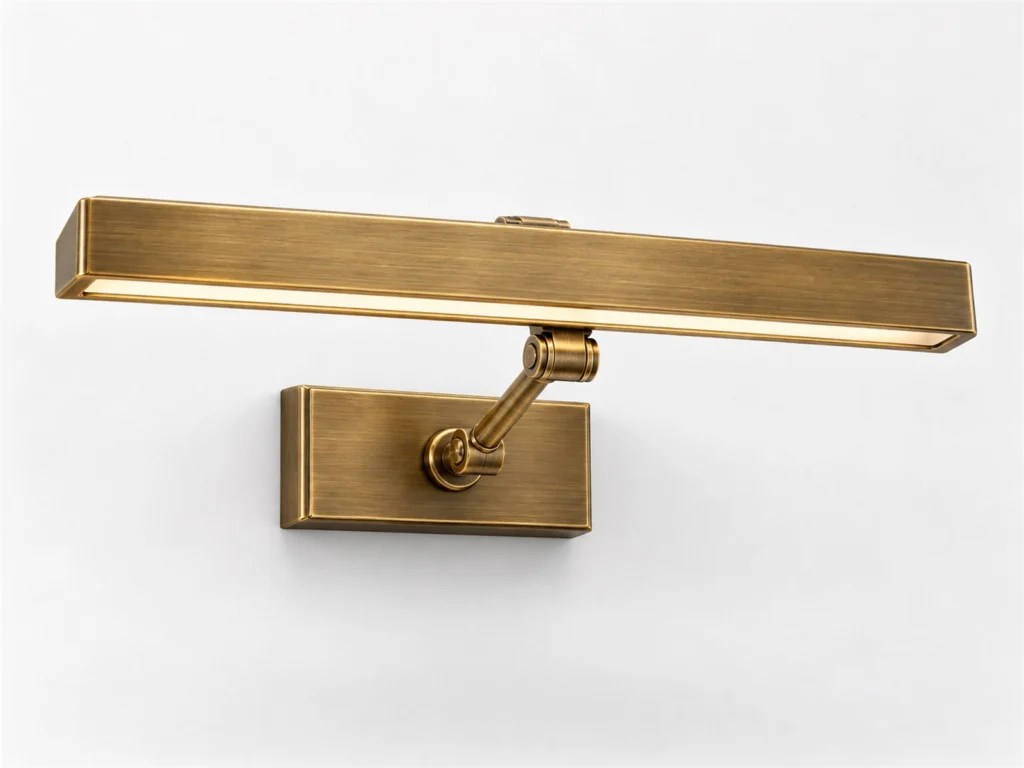
A picture light is a fitting mounted above a framed work — a canvas, a print, a photograph, a textile — so the light falls across the surface rather than into the room. We make them in hardwired, plug-in and rechargeable builds for importers, galleries, lighting brands and hotel projects, in our own factory in Shenzhen.
What a picture light does that a ceiling light cannot
A ceiling fitting lights the whole room, including the glass in front of the work. A picture light sits close to the surface, so the light can be aimed down the wall at a shallow angle: it shows the texture and the colour of the piece and leaves the room around it alone. The trade-off is that the fitting itself is visible, so the head has to keep its source out of sight from a standing viewer — which is why most picture lights are hooded or shielded at the front.
Choosing a length against the artwork
As a starting point, a picture light is chosen a little narrower than the frame it sits above, so the ends do not run past the frame's silhouette on a narrow wall. Common practice is roughly half to two-thirds of the artwork's width, widened when the work is very wide or the light sits far from the surface. That is a starting point, not a rule: the distance from the wall, the angle of the head and the beam a model produces all change the result, which is why we confirm a size against the actual artwork dimensions before quoting.
Arm reach, head angle and glare
The arm sets how far the head stands off the wall and the joint sets how far it can be tipped. Too close, and the beam concentrates into a hot band across the top of the frame; too far, and it spills into the room and can be seen from the side. A swivel or adjustable head lets the angle be set once the work is hung, and a hood or shield keeps the source out of sight from a normal viewing position.
Colour temperature and colour rendering
Two numbers decide most of the result. Colour temperature sets the warmth: 2700–3000 K is the usual range for residential and hospitality interiors, while a gallery on white walls often specifies cooler. Colour rendering decides whether the reds and skin tones in a painting stay themselves; a CRI of 90 and above is the usual requirement for artwork. We do not quote these from memory: each model's own datasheet or test report carries the figure, and where a model has no figure on record we say so rather than estimate it.
Hardwired, plug-in or rechargeable
The build decides the installation, so it is usually the first question on a project.
- Hardwired — a permanent connection and no cable on the wall. It needs a supply at the mounting point, and it is the choice when the wall is being opened anyway.
- Plug-in — a cable to a nearby socket. The fastest to install, but the cable and the socket become part of the picture wall.
- Rechargeable — no cable at all. The fitting is charged and returned to its bracket, which is the answer for stone walls, listed interiors and galleries that cannot be chased, as long as there is access to take it down to charge.
Finishes, and how they age
Brass, antique bronze, white and powder-coated colours are the usual choices. A lacquered brass stays near its original tone; an unlacquered one darkens with handling and air, which some projects want and others do not. Where a finish has to match a buyer's own catalogue, we send a physical sample rather than a screen colour.
Where picture lights are used
Museums and galleries, hotel and restaurant interiors, and homes — each with a different balance of glare control, colour quality and installation freedom. The applications pages describe what changes between them, and the wall light range covers the fittings that light a corridor or a stair wall rather than a single work.
What we need to quote
Send the models you are considering, or the artwork sizes and the room, with the quantities, the finish, the build and the target market. Standard terms are a 100 pcs MOQ, a 3–4 week production lead time, EXW or FOB, and a quotation valid for 15 days; a specific project can differ, and it is confirmed in writing. Certification and compliance are confirmed by model and market — this website prints no certification marks and claims no certification status.
For a requirement that is not in the catalogue, the OEM / ODM page explains private label and custom development, and the quality and testing page covers how a model is checked. To start, send the enquiry.